Orthodontic assessment record
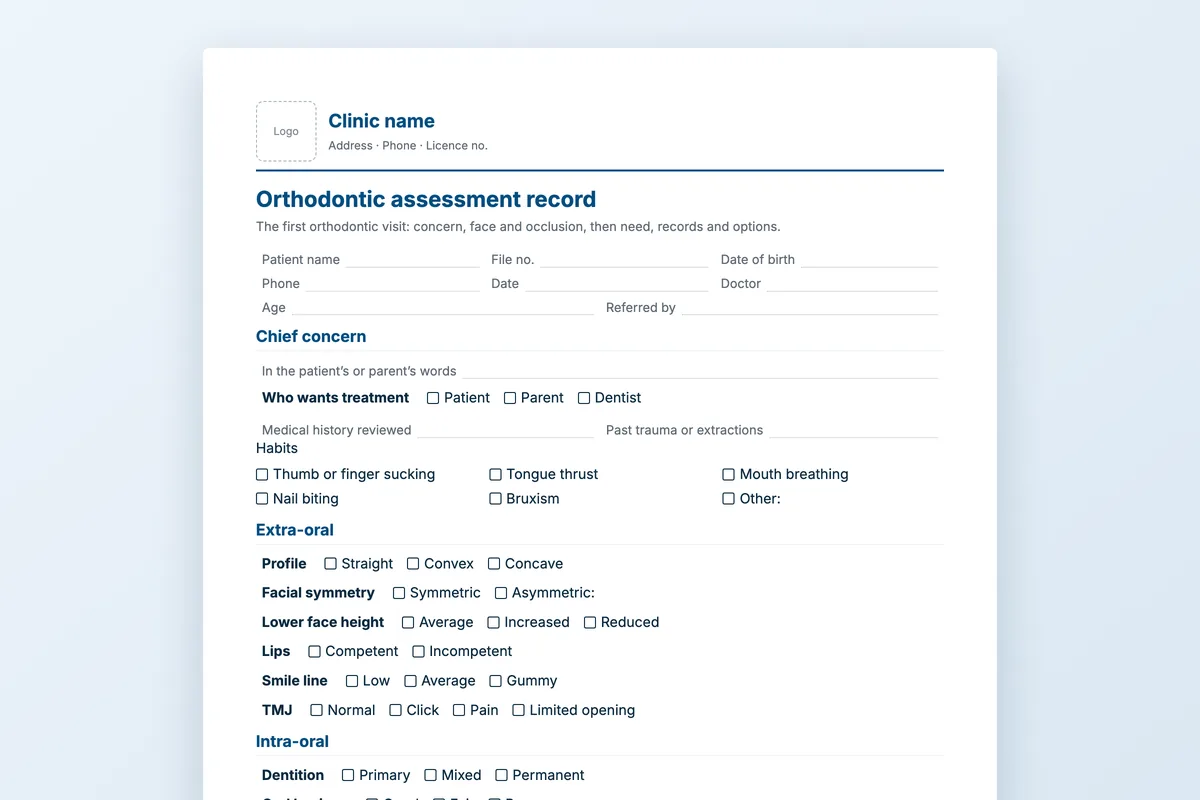
The first orthodontic consultation on two pages: what the patient or parent wants changed, the face and the bite, then the need, the records taken and the options you discussed, so the next visit starts from a decision rather than a recollection.
Download
- Word · English.docx · 40 KB
- PDF · English.pdf · 291 KB
- Word · Arabic.docx · 40 KB
- PDF · Arabic.pdf · 111 KB
FreeNo sign-upDownloads directly
What is on the two pages
| Concern and history | The concern in the patient’s or parent’s words, who is asking for treatment, history, past trauma or extractions, and habits from thumb sucking to bruxism. |
|---|---|
| Extra-oral | Profile, facial symmetry, lower face height, lip competence, smile line and TMJ. |
| Intra-oral | Dentition stage, hygiene, incisor class, overjet, overbite or open bite, both midlines, anterior crossbite and displacement; molar and canine class and posterior crossbites right and left. |
| Teeth and crowding | An FDI chart to mark missing, impacted and unerupted teeth, and crowding or spacing in millimetres for each arch with its severity. |
| Need, records and options | The clinician’s grading of need, the patient’s aesthetic concern, records taken from photos to CBCT, a problem list, and options A, B and C with appliance, extractions, duration and retention. |
How to use it
Start with the concern
Write it in their words. A parent’s worry and a teenager’s are often different, and both matter at consent.
Examine right and left separately
Molar and canine class, and crossbites, each have a right and a left column.
List the records taken
Tick what you took today, so nobody books a second set of photos.
Close with the options
Write at least two options and no treatment, the duration for each, and the date the consent form was signed.
Who it is for
Orthodontists and general dentists who offer fixed appliances or aligners, and clinics where one dentist assesses and another treats. The options table also helps the front desk prepare a payment plan before the treatment visit.
Read next
Patient journey
Drag-and-drop calendar per room and doctor, online booking, waiting lists and no-show tracking, from first contact through to recall.
Read more From the blogOrthodontic instalments: managing 18 months of payments and visits without losing money
An orthodontic case is not a treatment you invoice. It is a financial agreement that runs a year and a half, a visit every four weeks, and…
Read moreMore free files
Questions
Does it use IOTN?
No licensed index is reproduced. The need is the clinician’s own grading from none to great, and there is a field for the name and grade of whichever index your clinic uses.
Is this a consent form?
No. It records the date consent was signed on a separate form, which the free consent tool on this site can prepare for orthodontic treatment.
Does it work for aligner cases?
Yes. The options table takes fixed, aligners, removable or functional appliances, and the records list includes the intra-oral scan.
Can I record a payment plan?
There is a line to note that one was agreed. The orthodontic payment plan calculator on this site works out the instalments.
From consultation to the last retainer check
In Dentolize the assessment, the records, the payment plan and every adjustment visit follow the patient’s journey in one file. Thirty minutes on your own clinic.