Dental examination and charting record
The new-patient examination, written down in the order you actually do it: what brought them in, what the history changes, what you see outside and inside the mouth, then the chart, the diagnosis and the plan.
Download
- Word · English.docx · 45 KB
- PDF · English.pdf · 329 KB
- Word · Arabic.docx · 45 KB
- PDF · Arabic.pdf · 132 KB
FreeNo sign-upDownloads directly
Rather fill it in on screen? Printable dental chart
What is on the three pages
| Complaint and medical alerts | Visit type, the complaint in the patient’s words, pain score, and ticks for the alerts that change dental care: anticoagulants, bisphosphonates, heart valves, diabetes, pregnancy, penicillin, latex and local anaesthetic reactions, radiotherapy, smoking. |
|---|---|
| Clinical examination | Extra-oral and intra-oral soft tissue side by side, NAD or a finding for each area, maximum opening, and an oral cancer screen with a box for urgent referral. |
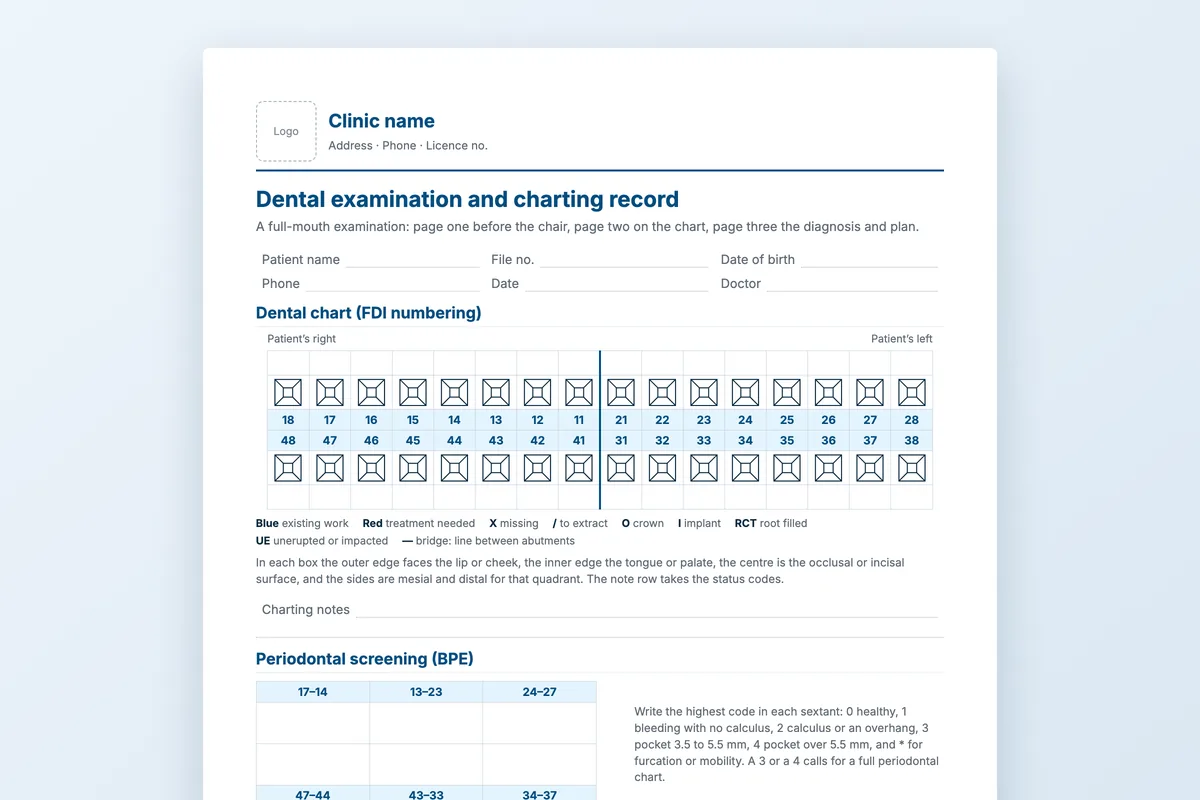
| FDI dental chart | All 32 permanent teeth, patient’s right on your left, each with a five-surface box and a note row for status codes, plus a key for existing work, needed treatment, missing teeth, crowns, implants and root fillings. |
| BPE, hygiene and occlusion | Six sextant boxes with the code key, plaque, calculus and staining, molar and canine class, overjet, overbite, crossbites and wear. |
| Radiographs, diagnosis and plan | Each image with its justification and findings, diagnosis by tooth, caries risk, periodontal status and a plan in four phases with estimates. |
How to use it
Put it on your letterhead
Open the Word file and replace the logo box and clinic lines at the top. The layout keeps its size.
Page one before the chair
Take the complaint and go through the alerts with the patient while the history questionnaire is still in your hand.
Chart in two colours
Existing work in blue, treatment needed in red, codes in the note row. Score the BPE and decide whether a full perio chart is due.
Close with the plan
Write the diagnosis by tooth, phase the treatment, and have the patient sign that the options were explained.
Who it is for
General dental practices that still examine on paper, or want a printed record beside the screen: new patient examinations, recall exams and second opinions. It also works as a teaching sheet for interns and newly qualified dentists, because it walks the examination in order and leaves nothing to memory.
Read next
Dental chart
Chart treatments, track conditions and record operations digitally. Dentolize's interactive dental chart replaces paper with a fast, visual one.
Read more From the blogDigital tooth chart: why the chart should be the patient record, not a picture inside it
A paper tooth chart is filled in at the first visit with a blue pen and never updated. The second dentist opens it a year later and sees a…
Read moreMore free files
Questions
Why FDI numbering?
It is the two-digit system most clinics in the Gulf, Egypt and Europe use: quadrant first, then the tooth, so 36 is the lower left first molar. If you use Universal, the free tooth numbering converter on this site translates.
How do the five-surface boxes work?
The outer edge of each box faces the lip or cheek, the inner edge the tongue or palate, the centre is the biting surface and the sides are mesial and distal. Shade the surface involved.
Is the BPE here enough for a perio patient?
No. A code 3 or 4 calls for a full six-point chart; the periodontal charting form on this site is made for that.
Can I fill it on screen?
The printable dental chart tool fills a chart in the browser and prints it on your letterhead. The examination record itself is meant to be printed or edited in Word.
The chart that remembers the last visit
In Dentolize the examination is charted on the patient’s own tooth chart, the plan becomes a quotation in one step, and the next exam starts from what you found this time. Thirty minutes on your own clinic.