Root canal treatment record
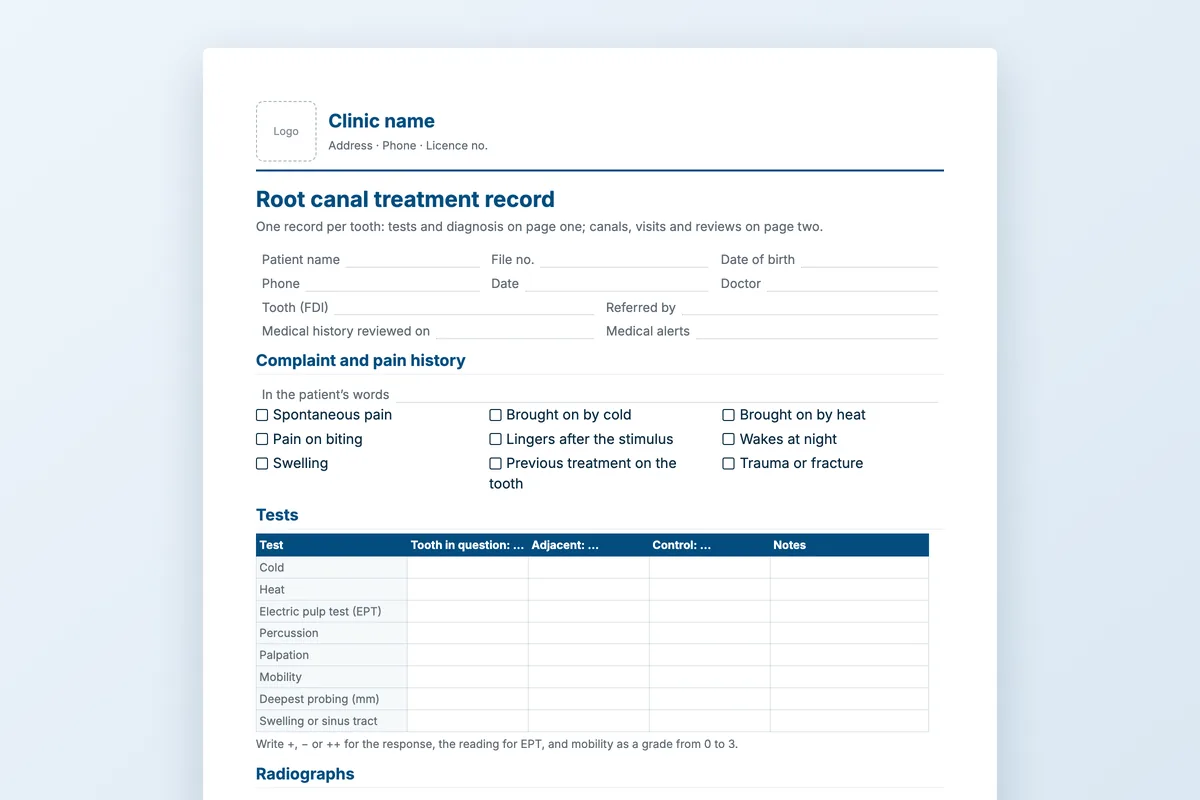
One record per tooth, from the first test to the four-year review. Page one holds the evidence for the diagnosis; page two holds what was done in each canal and when the tooth is next seen.
Download
- Word · English.docx · 40 KB
- PDF · English.pdf · 269 KB
- Word · Arabic.docx · 40 KB
- PDF · Arabic.pdf · 103 KB
FreeNo sign-upDownloads directly
What is on the two pages
| Complaint and tests | Pain history ticks, then cold, heat, EPT, percussion, palpation, mobility, deepest probing and swelling for the tooth in question, an adjacent tooth and a control. |
|---|---|
| Radiographs | Periapical tissues, roots and canals, resorption or fracture, and the CBCT reference when there is one. |
| Diagnosis | Pulpal and periapical side by side, in the terms endodontists use, then the treatment chosen and the prognosis. |
| Canals and visits | For each canal the reference point, estimated and working length, master apical file and size, taper and obturation technique; irrigants, activation, intracanal medicament and temporary named, and a line per visit. |
| Restoration and reviews | The final restoration and when, then reviews at 6 and 12 months, 2 and 4 years with a healed, healing or not healed radiographic verdict. |
How to use it
Test before you numb
Record each test on the tooth, a neighbour and a control. A test without a control proves little.
Write the diagnosis in two halves
Pulp and periapical tissues are diagnosed separately; tick one of each.
Fill the canal table as you go
Lengths at the working length film or apex locator reading, file and taper at shaping, technique at obturation.
Book the reviews before they leave
Write the review dates into the follow-up table and into your diary on the same day.
Who it is for
General dentists who do their own root canal treatment and endodontists who receive referrals, especially where the referring dentist expects a written account back. The canal table is the part a colleague needs when the tooth is retreated years later.
Read next
Dental chart
Chart treatments, track conditions and record operations digitally. Dentolize's interactive dental chart replaces paper with a fast, visual one.
Read more From the blogDigital tooth chart: why the chart should be the patient record, not a picture inside it
A paper tooth chart is filled in at the first visit with a blue pen and never updated. The second dentist opens it a year later and sees a…
Read moreMore free files
Questions
Why are there no doses or concentrations?
The form names the irrigants and medicaments used and leaves the choice of product and concentration to the dentist. Record what you used in the visit line.
Which diagnostic terms does it use?
The pulpal and periapical terms that endodontic textbooks and specialist societies use, such as symptomatic irreversible pulpitis and asymptomatic apical periodontitis.
Why review for four years?
Most periapical lesions show healing within a year, but some take longer. A four-year line lets you call a tooth healed, or catch one that is not.
Where does consent go?
The record has a line for the date consent was signed. The consent itself belongs on a consent form, which the free consent tool on this site can produce.
Every canal, on the tooth it belongs to
In Dentolize the treatment notes, radiographs and review dates sit on the tooth in the patient’s chart, and the recall reminder goes out on its own. Thirty minutes on your own clinic.