Dental implant treatment record
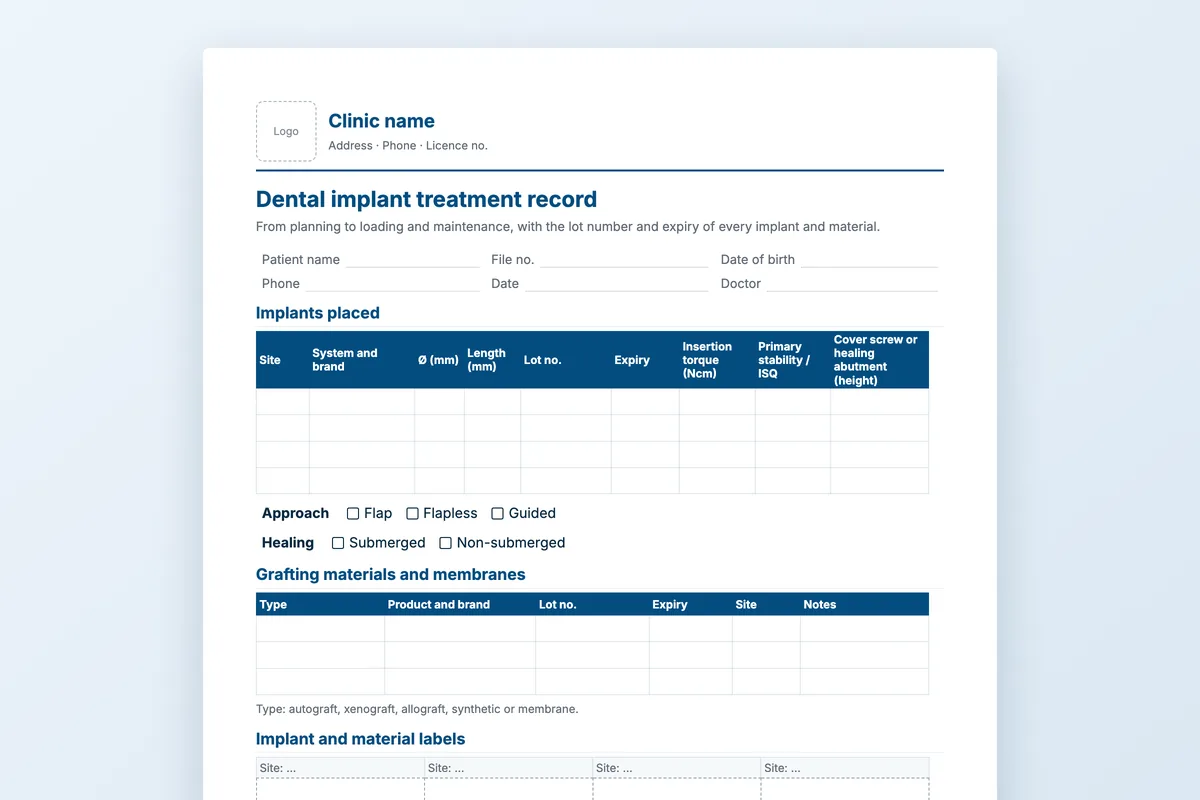
The implant case from planning to maintenance on three pages, built around the question a recall notice asks: which patient received which lot. Each implant and graft has its lot, its expiry and a box for its label.
Download
- Word · English.docx · 40 KB
- PDF · English.pdf · 274 KB
- Word · Arabic.docx · 41 KB
- PDF · Arabic.pdf · 103 KB
FreeNo sign-upDownloads directly
What is on the three pages
| Risk and site assessment | Smoking, diabetes, antiresorptive medication, radiotherapy, anticoagulants, periodontitis and bruxism; then bone width, height and quality, keratinised tissue and biotype per site, the CBCT reference and the planned restoration. |
|---|---|
| Implants placed | Site, system and brand, diameter, length, lot number, expiry, insertion torque, primary stability or ISQ, and the cover screw or healing abutment. |
| Grafts and labels | Each graft or membrane with product, lot and expiry, and dashed boxes for the implant and material labels, four sites across. |
| Loading and prosthetics | Immediate, early or conventional loading, then impression, try-in and fit with the abutment lot, screw torque, screw or cement, and the lab. |
| Maintenance reviews | Deepest probing, bleeding, suppuration, bone level on the radiograph, mobility and what was done, a line per visit. |
How to use it
Assess before you plan
Fill page one with the CBCT on the screen, one line per site.
Stick the labels in theatre
The nurse sticks each implant and graft label in its box as it is opened, and copies lot and expiry into the table.
Record torque and stability
Write insertion torque and ISQ at placement, and ISQ again at uncovering, before you choose when to load.
Keep the reviews on the same record
Probe the implant at each maintenance visit and compare the bone level with the radiograph at fit.
Who it is for
Clinics placing or restoring implants, whether one surgeon or several, and the nurses who run the theatre. It suits clinics that buy implants in boxes and want to know, months later, exactly which lot went into which patient.
Read next
Inventory
Stock deducted automatically as procedures complete, plus expiry tracking, reorder alerts and purchase orders. Accurate without a stock take.
Read more In DentolizeDental chart
Chart treatments, track conditions and record operations digitally. Dentolize's interactive dental chart replaces paper with a fast, visual one.
Read more From the blogDental implant tracking: the implant is a part with a number, the case is a path with stages
A patient comes back after three years with a loose implant and asks about the warranty. Which implant? Which brand? Which lot? Who placed…
Read moreMore free files
Questions
Why stick the label in as well as writing the lot?
A label cannot be misread or mistyped. If a manufacturer recalls a lot, the label in the record is the proof of what was placed.
What is ISQ?
The implant stability quotient, read by a resonance frequency device. Clinics without one record primary stability as torque and a clinical judgement; the column takes either.
Does it cover bone grafting and sinus lifts?
Yes. Augmentation is ticked on page one and every material used goes in the graft table with its lot and expiry.
Does it include post-operative instructions?
It records that written instructions were given. The free aftercare tool on this site prints general post-implant care to adapt to your clinic.
Implant stock with its expiry dates watched
In Dentolize implants and materials are held in stock with the expiry date of each batch, and deducted when the procedure is completed on the patient’s chart. Thirty minutes on your own clinic.